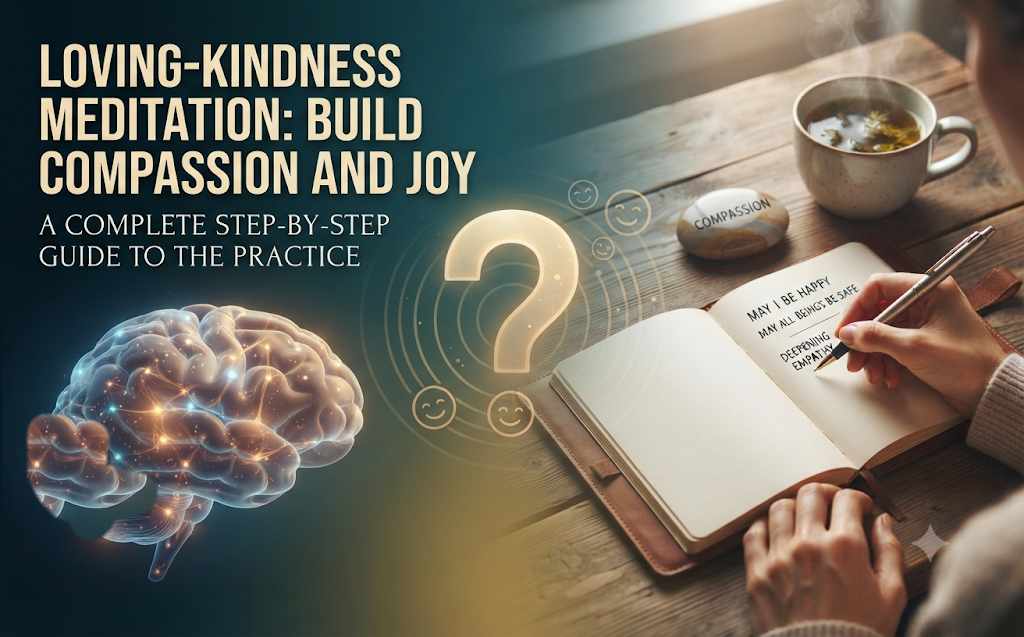
Loving-kindness meditation — known in the Buddhist tradition as metta (Pali for "benevolence" or "goodwill") — is a practice of systematically directing wishes of wellbeing toward oneself and others. Unlike attention-focused mindfulness practices that train present-moment awareness, loving-kindness meditation is a generative practice — it actively cultivates positive emotional states rather than simply observing whatever arises. This makes it particularly powerful for people struggling with self-criticism, social anxiety, loneliness, difficulty feeling compassion, or chronic negative emotion patterns.
Research on loving-kindness meditation has expanded dramatically in the past decade, establishing it as one of the most evidence-supported compassion-based interventions in psychology. Here's what the science shows and a complete step-by-step guide to the practice.
Quick TakeawayLoving-kindness meditation works by deliberately generating feelings of warmth and goodwill — toward oneself, then toward others in expanding circles. Research has found it produces increases in positive emotions, reduced depression and self-criticism, improved social connection, greater empathy and reduced implicit bias, and even reduced chronic pain — with neurological changes measurable after just 7 hours of cumulative practice.
What the Research Shows
Psychologist Barbara Fredrickson at the University of North Carolina has conducted some of the most influential research on loving-kindness meditation. A 2008 randomized trial found that seven weeks of loving-kindness meditation produced significant increases in daily positive emotions — love, joy, gratitude, contentment, hope, pride, interest, amusement, and awe — which in turn produced increases in a range of personal resources including mindfulness, sense of purpose, social support, and decreased illness symptoms. These gains persisted even after the meditation practice itself ended.
Brain imaging research has found that loving-kindness practice activates the insula and anterior cingulate cortex — brain regions involved in empathy and emotional self-awareness — to a greater degree than other forms of meditation. A study by Stefan Hofmann found that loving-kindness meditation significantly reduced self-criticism and depression in people with high levels of self-critical thinking — a finding with significant implications for the large population of Americans who struggle with inner critic patterns.
Research at Stanford's Center for Compassion and Altruism Research has found that even brief loving-kindness practice (as little as 7 minutes) produced measurable increases in feelings of social connection and positivity toward strangers — suggesting rapid and accessible effects even for beginners.
How to Practice Loving-Kindness Meditation
Setup
Find a comfortable seated position — in a chair or on the floor — with your spine upright and your hands resting softly in your lap. Close your eyes. Take three slow breaths to settle the body and begin shifting from the doing mode of everyday life to the being mode of meditation. Allow a slight smile — even a gentle, barely perceptible upward curl of the lips — which research has found can prime positive emotional states through facial feedback.
Phase 1 — Loving-Kindness Toward Yourself (5 minutes)
Begin with yourself — this is where most people find the practice most challenging, and where its healing power is often most needed. Many Americans have a harsh internal critic and find it genuinely difficult to wish themselves wellbeing without it feeling false or self-indulgent. Start by bringing to mind an image of yourself — perhaps a younger, more vulnerable version, or simply yourself as you are now. Then silently repeat these traditional phrases (or your own words that carry the same meaning):
May I be happy.
May I be healthy.
May I be safe.
May I live with ease.
Repeat these phrases slowly, with as much warmth and genuine intention as you can access. If the words feel hollow or forced at first — this is normal, particularly for self-directed kindness. Simply continue repeating with the intention of goodwill, even when the feeling isn't yet strong. Research has found that the intention itself produces the neurological benefit, even when the emotional warmth isn't immediate.
Phase 2 — A Beloved Person (3 minutes)
Bring to mind someone you love easily and naturally — a close friend, a family member, a pet, a teacher you cherish. Allow the natural warmth you feel for this person to arise, then direct the same phrases toward them:
May you be happy.
May you be healthy.
May you be safe.
May you live with ease.
This phase is typically the easiest — the natural affection for a loved one makes generating genuine goodwill straightforward. Use this phase to amplify the felt sense of loving-kindness before expanding it outward.
Phase 3 — A Neutral Person (3 minutes)
Bring to mind someone you neither like nor dislike — a neighbor you rarely speak with, a checkout clerk at the grocery store, someone you see regularly but don't know. This person also wants to be happy, to be free from suffering, to be safe. Direct the same phrases to them. This phase trains the generalization of compassion beyond our natural "in-group" of loved ones — expanding the circle of people whose wellbeing we hold.
Phase 4 — A Difficult Person (3 minutes)
Bring to mind someone you have difficulty with — not the most challenging person in your life (which can be overwhelming for beginners) but someone mildly difficult: a frustrating colleague, someone who cut you off in traffic, a neighbor who annoys you. Recognizing that this person, like you, wants to be happy and free from suffering, direct the phrases toward them. This is the most demanding phase — it is here that the practice does its most transformative work on the quality of compassion.
Phase 5 — All Beings (2 minutes)
Expand your awareness outward in concentric circles — your neighborhood, your city, your country, the world — directing loving-kindness to all beings everywhere without exception:
May all beings be happy.
May all beings be healthy.
May all beings be safe.
May all beings live with ease.
Allow the felt sense of goodwill to expand with each outward circle until it feels boundless. Then slowly return awareness to your breath, to the room, and to your body before opening your eyes gently.
When to Practice and How Often
Even 10–15 minutes of loving-kindness practice 3–5 times per week produces meaningful cumulative benefits based on research timelines. Morning practice sets a warm, socially connected tone for the day. Evening practice before bed can ease the day's interpersonal frictions and support more restful sleep. Many people find that even brief loving-kindness practice — 2–3 minutes of phrase repetition during a commute or between meetings — produces a noticeable shift in mood and social openness.
Frequently Asked Questions
What if I can't feel warmth or the phrases feel meaningless?
This is one of the most common beginner experiences with loving-kindness practice — and it does not mean the practice isn't working. Research has found neurological and psychological benefits from loving-kindness practice even when participants report not experiencing strong emotional warmth during sessions. The intention and the repetition of the phrases are themselves the practice. Some teachers suggest starting with a very easy target — a beloved pet often works well for people who struggle with self-directed kindness — and allowing the warmth generated there to become the foundation for extending to more difficult targets. Over 2–4 weeks of consistent practice, most people begin to notice genuine feelings of warmth arising more easily.
Do I have to use the traditional phrases or can I use my own words?
The traditional phrases (happy, healthy, safe, ease) are widely used because decades of research have validated their effectiveness — and because their simplicity makes them easy to remember and repeat in a meditative state. However, you can absolutely adapt them to words that feel more natural and resonant for you. Some people use: "May I be well. May I be at peace. May I be free from suffering." Others create phrases specific to what they most need or what they most wish for those they're directing kindness toward. The key is genuine intention toward wellbeing — the specific words are the vehicle, not the destination.
Medical Disclaimer: This article is for informational and educational purposes only. Loving-kindness meditation is a wellness practice and is not a substitute for professional mental health treatment. If you are experiencing clinical depression, anxiety, trauma, or other mental health conditions, please consult a qualified mental health professional.