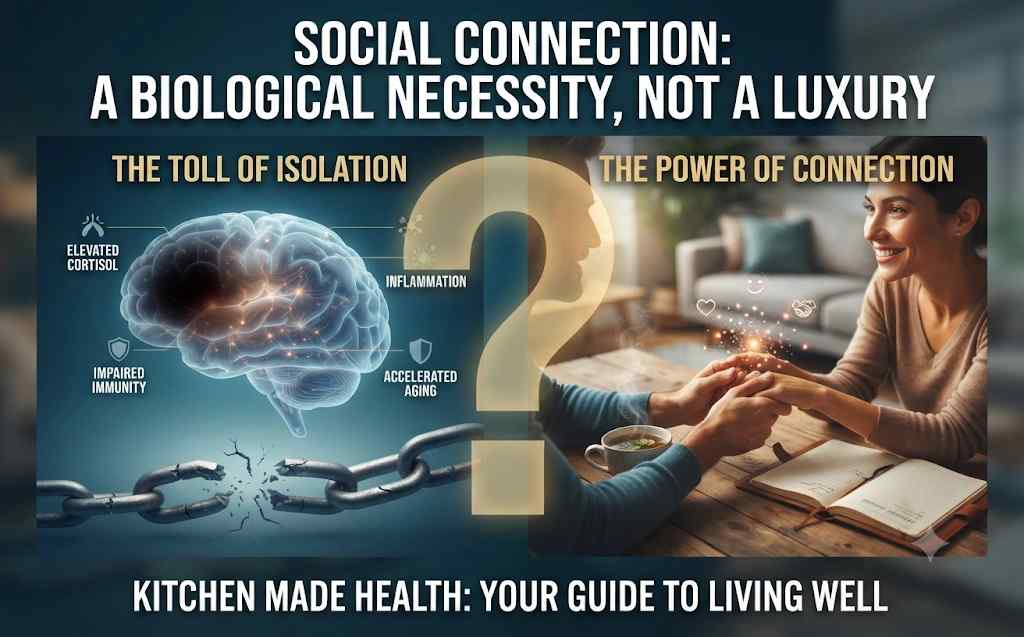
In May 2023, US Surgeon General Dr. Vivek Murthy issued an advisory declaring loneliness and social isolation a public health epidemic in America — citing research showing that more than half of American adults report measurable levels of loneliness. The declaration placed social connection alongside diet, exercise, and sleep as a fundamental pillar of health — not a luxury or a personality preference, but a biological necessity with measurable consequences when absent.
The research supporting this designation is compelling and has accumulated across multiple decades and dozens of research groups worldwide. Here's what the science actually shows about social connection and health — and what you can do about it.
Quick TakeawayChronic loneliness increases the risk of premature death by 26%, is associated with a 29% increased risk of heart disease, 32% increased risk of stroke, and significantly elevated risks of depression, anxiety, dementia, and immune dysfunction. The biological mechanisms are well-understood — loneliness activates the same stress response as physical threat, maintaining elevated cortisol, inflammation, and sympathetic nervous system activity chronically.
The Biology of Loneliness
Loneliness is not simply an emotion — it is a biological state with measurable physiological consequences. Researchers John Cacioppo and William Patrick, who spent decades studying loneliness, found that it activates the body's threat response in ways strikingly similar to physical danger. Lonely individuals show elevated cortisol, increased sympathetic nervous system activity, higher levels of inflammatory cytokines, impaired immune function, disrupted sleep architecture, and accelerated biological aging (shorter telomere length).
Cacioppo proposed that loneliness evolved as a warning signal — just as hunger signals the need for food and pain signals tissue damage, loneliness signals a threat to social belonging that was genuinely life-threatening in evolutionary environments where isolation meant vulnerability to predators and exclusion from food-sharing groups. The problem is that this biological alarm system, designed for short-term activation, produces serious harm when chronically activated in the conditions of modern isolated living.
What the Research Shows About Health Consequences
Cardiovascular Disease and Stroke
A meta-analysis published in Heart analyzing 23 studies found that social isolation increased coronary heart disease risk by 29% and stroke risk by 32% — effects comparable in magnitude to well-established cardiovascular risk factors like obesity and physical inactivity. The proposed mechanisms include chronically elevated cortisol damaging blood vessels, increased inflammatory markers promoting atherosclerotic plaque formation, and disrupted sleep reducing cardiovascular recovery.
Dementia Risk
Social isolation is consistently identified as one of the most significant modifiable risk factors for dementia. A 2022 Lancet Commission on dementia prevention identified social isolation as responsible for approximately 4% of dementia cases worldwide — making it comparable in impact to hypertension and physical inactivity. Proposed mechanisms include reduced cognitive stimulation from social interaction (the "use it or lose it" effect on neural networks), increased depression (itself a dementia risk factor), and reduced motivation for the health behaviors that protect brain health.
Immune Function
Loneliness measurably impairs immune function through multiple pathways. A study by Sheldon Cohen at Carnegie Mellon University found that lonely people exposed to cold viruses were significantly more likely to develop clinical illness than well-connected people at the same exposure level. The mechanism involves chronic stress hormone suppression of natural killer cell activity and T-cell responsiveness — the cellular immune components most important for fighting viral infections.
Mental Health
The relationship between loneliness and depression is bidirectional and well-established: loneliness predicts subsequent depression, and depression predicts subsequent loneliness, in a reinforcing cycle that can be difficult to interrupt. Loneliness also predicts anxiety disorders, suicidal ideation, and substance use disorders — making it a significant upstream risk factor for a wide range of mental health conditions.
Why Modern America Is So Lonely
Several structural changes have converged to produce the current loneliness epidemic. Social media provides the appearance of connection while research consistently finds it reduces the quality of social bonds. Remote work has eliminated the incidental social contact of office environments. Urban and suburban design prioritizes cars over walkable spaces where casual social interaction occurs naturally. Americans report having fewer close friends than in previous generations — the average American had 2.94 close friends in 1990 and 2.09 in 2021, according to Gallup data. Marriage rates have declined. Religious participation — historically one of the most reliable sources of community — has dropped significantly.
Practical Strategies for Building Social Connection
Prioritize Quality Over Quantity
Research consistently finds that the depth and quality of social connections matters more than the number. One genuinely close, reciprocal friendship is more protective than a large network of superficial acquaintances. Focus energy on deepening existing relationships rather than expanding social networks broadly.
Consistent, Repeated Contact Creates Closeness
Research on friendship formation finds that proximity and repeated incidental contact are the most powerful predictors of friendship development — not shared interests or personality compatibility. Join a class, club, volunteer organization, or religious community where you see the same people weekly. Consistency of contact is the raw material from which genuine closeness grows.
Vulnerability Accelerates Connection
Research by Brené Brown and others has found that self-disclosure — sharing something real and personal about yourself — is the mechanism that transforms acquaintances into friends. Casual surface conversation maintains distance; genuine vulnerability creates the reciprocal intimacy that characterizes close friendship. One meaningful personal conversation is worth more for connection than dozens of pleasant but shallow interactions.
Give More Than You Receive
Counterintuitively, research finds that acts of social giving — reaching out to check on others, offering help, expressing appreciation — increase the giver's sense of connection as much or more than receiving social support. Loneliness often produces social withdrawal and passivity; actively giving social attention reverses this pattern and tends to generate reciprocal connection.
Use Technology as a Bridge, Not a Substitute
Digital communication — texts, social media, video calls — is most beneficial for maintaining existing in-person relationships between face-to-face contacts. It is least effective as a substitute for in-person connection. Use it to arrange in-person meetings rather than as the primary mode of relationship maintenance.
Frequently Asked Questions
Is it possible to be lonely even when surrounded by people?
Yes — loneliness is defined by the subjective experience of disconnection, not by the objective number of people present. Many people report profound loneliness in marriages, in busy workplaces, and in crowded cities. Conversely, people who live alone and see others infrequently can feel deeply connected and socially satisfied. The relevant variable is the quality and authenticity of connection experienced — not proximity to other humans. This distinction is important because interventions that simply add social exposure (putting lonely people in group settings) often fail, while interventions that support genuine relational depth are more effective.
Can pets reduce loneliness?
Research suggests pet ownership provides some protection against the health effects of social isolation — particularly for older adults living alone. Pets provide consistent companionship, physical affection, a sense of being needed, and often serve as social catalysts (dog owners interact with more strangers than non-dog owners). However, pets do not fully replace human social connection and should be considered a supplement to, not a substitute for, human relational investment. The health benefits of pet ownership appear most robust when pets are added to a life that includes some human connection, rather than as the primary social relationship.
Medical Disclaimer: This article is for informational and educational purposes only. If you are experiencing significant loneliness, depression, or social anxiety that impairs your daily functioning, please consult a qualified mental health professional. For crisis support, dial or text 988.