Emotional spiraling is the experience most people describe as "one thing leads to another until I'm convinced everything is terrible." It begins with a triggering thought or event, is amplified by the brain's threat-detection system, and cascades through association networks until mild concern becomes catastrophe and manageable stress becomes overwhelming anxiety. It feels inevitable when you're in it — but it has specific neurological mechanisms that can be interrupted at multiple points.
These techniques are drawn from Cognitive Behavioral Therapy (CBT), Acceptance and Commitment Therapy (ACT), dialectical behavior therapy (DBT), and neuroscience — all adapted for real-time, in-the-moment use without a therapist present.
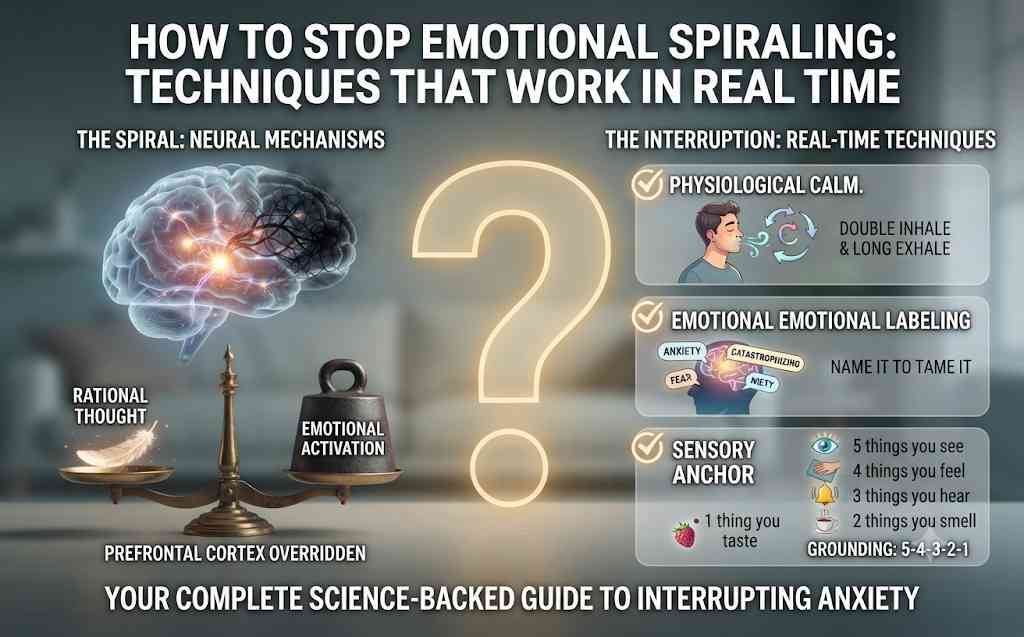
Quick TakeawayA spiral begins when the amygdala (the brain's threat detector) is activated and overrides prefrontal cortex (rational thinking) function — a process called amygdala hijack. Every effective real-time spiral interruption technique works by either reactivating the prefrontal cortex, reducing amygdala activation through physiological calming, or redirecting cognitive attention away from the spiral content.
Understanding Why Spirals Happen Neurologically
The amygdala — the brain's threat detection center — is designed to respond faster than conscious thought. When it detects a threat (real or imagined), it triggers a cascade of stress hormones before the prefrontal cortex can evaluate whether the threat is real, proportionate, or even likely. In people prone to emotional spiraling, this threat detection system is sensitized — it fires more easily, for longer, and with less provocation than in people with more regulated emotional systems.
Once the amygdala is activated and cortisol and adrenaline flood the system, the prefrontal cortex — which handles rational evaluation, perspective-taking, and problem-solving — is effectively taken offline. This is why "just think rationally about it" advice doesn't work during a spiral: the brain structure required for rational thinking is temporarily unavailable. Effective spiral interruption must first restore physiological calm before cognitive reappraisal becomes possible.
Technique 1 — Physiological Sigh (30 Seconds)
The physiological sigh is a specific breathing pattern — double inhale through the nose followed by a long exhale through the mouth — that is the fastest known intervention for acute stress and emotional activation. Research by Andrew Huberman's lab at Stanford found the physiological sigh is more effective than mindfulness meditation, box breathing, or simple slow breathing for rapidly reducing physiological stress arousal.
The mechanism: the double inhale fully inflates the lung's alveoli (small air sacs that partially collapse during sustained stress breathing), maximizing the surface area for CO2 exchange. The long exhale removes CO2 more effectively than normal breathing, which directly slows heart rate through the vagus nerve. Practice: inhale fully through the nose, take a second sharp sniff to fully top off the lungs, then release with a long slow exhale through the mouth. Repeat 2–3 times. This can interrupt an emerging spiral within 30–60 seconds.
Technique 2 — Name It to Tame It (Emotional Labeling)
Neuroscience research by Matthew Lieberman at UCLA found that labeling emotions — putting words to what you're feeling — reduces amygdala activation and increases prefrontal cortex activity. The act of naming an emotion shifts processing from the reactive limbic system to the analytical prefrontal cortex, literally changing which brain region is in charge of the experience. This is the neurological basis for the therapy truism "name it to tame it."
During a spiral, pause and explicitly name what you're experiencing: "This is anxiety about the meeting." "I'm feeling catastrophizing thoughts about what might happen." "This is fear that I won't be enough." The more specific and accurate the label, the stronger the amygdala-calming effect. Research found that even a simple written label produces measurable reductions in physiological stress arousal within minutes.
Technique 3 — The 5-4-3-2-1 Sensory Anchor
Spiraling happens in the mind's projections into the future (catastrophizing) or ruminative loops about the past — never in the present sensory moment. The 5-4-3-2-1 grounding technique interrupts the spiral by forcefully redirecting attention to present-moment sensory reality: identify 5 things you can see, 4 you can physically feel right now (the texture of clothing, the temperature of air, the pressure of your feet on the floor), 3 you can hear, 2 you can smell, 1 you can taste. This systematic sensory inventory occupies the verbal-analytical mind that generates spiral content and replaces it with direct sensory experience — which cannot coexist with anxious future projection.
Technique 4 — Thought Defusion (ACT Technique)
Acceptance and Commitment Therapy's defusion technique interrupts the spiral by changing the relationship to thoughts rather than trying to stop them. A spiraling thought like "I'm going to fail and everyone will see it" is treated not as a fact but as a mental event: "I notice I'm having the thought that I'm going to fail and everyone will see it." Adding "I notice I'm having the thought that..." creates psychological distance between you and the thought content, reducing its emotional impact without requiring you to disprove or argue against it.
Research has found thought defusion more effective than cognitive challenging (arguing against negative thoughts) for reducing the emotional impact of anxious thoughts — particularly for people who find argument with their thoughts produces more rumination rather than less. The thought is allowed to exist; you simply observe it rather than fusing with it.
Technique 5 — Pattern Interrupt (Behavioral)
The neurological spiral pattern is partly self-reinforcing through environmental cues — sitting in the same chair, staring at the same screen, staying in the same room that associated with the spiral. A physical pattern interrupt — standing up, changing location, going outside, splashing cold water on the face — breaks the associative chain and provides a genuine state change that gives other techniques a foothold. Cold water on the face in particular activates the mammalian dive reflex, which directly slows heart rate and reduces sympathetic nervous system activity.
Technique 6 — The 90-Second Rule (Jill Bolte Taylor)
Neuroscientist Jill Bolte Taylor observed that the physiological component of any emotion — the neurochemical cascade triggered by an emotional event — lasts approximately 90 seconds if not re-triggered by continued thought. After 90 seconds, the chemicals flush from the bloodstream and the emotional intensity naturally reduces. The spiral perpetuates the emotional state by continuously re-triggering it through rumination — feeding it new content that keeps the amygdala activated beyond the natural 90-second resolution window.
Applying the 90-second rule: when you feel a spiral beginning, set a 90-second timer and observe the emotional experience without adding new thoughts to it — simply witness the physical sensations (heart rate, breathing, body tension) without mentally narrating or analyzing them. Research supports this allowing approach as more effective than suppression or distraction for emotional resolution.
Frequently Asked Questions
What's the difference between a normal worry and a spiral?
Normal worry is a single thought about a specific problem — often adaptive, motivating appropriate action. A spiral is a cascade: one triggering thought activates a chain of associated threatening thoughts, each amplifying the emotional intensity of the last. Spirals are characterized by their self-amplifying quality (each thought feels more catastrophic than the previous one), their disconnection from present reality (projecting into worst-case futures), and the accompanying physiological activation (racing heart, tight chest, shallow breathing). The key diagnostic question: "Am I thinking through a problem productively, or am I generating increasingly distressing scenarios?" If it's the latter, it's a spiral.
Can these techniques replace therapy for anxiety?
These techniques are self-help adaptations of evidence-based therapeutic methods — they provide meaningful real-time relief and are genuinely effective for situational anxiety and stress. They are not a substitute for professional treatment of anxiety disorders, trauma, OCD, or clinical depression. If spiraling is frequent, severe, or significantly impairs daily functioning, please consult a qualified mental health professional. CBT and ACT — the frameworks most of these techniques draw from — are highly effective therapies that produce more comprehensive and lasting change with professional guidance than self-application alone. For crisis support, dial or text 988.
Medical Disclaimer: This article is for informational and educational purposes only. These techniques are wellness tools, not clinical treatments. For clinical anxiety, depression, trauma, or other mental health conditions, please consult a qualified mental health professional.