Among the many forms of meditation, mantra meditation is distinguished by its simplicity and its accessibility to people who struggle with other techniques. Where breath-focused meditation requires sustained attention to a subtle physical sensation — which can feel elusive for beginners — mantra meditation provides a concrete, repeatable anchor: a word, sound, or short phrase that the mind returns to with each repetition. This concrete anchor makes it easier for many people to maintain focus and reduces the frustration of the "wandering mind" that discourages beginners from other meditation styles.
Mantra meditation is the foundation of Transcendental Meditation (TM), one of the most extensively researched meditation modalities in clinical science, and is also central to various Hindu, Buddhist, Christian (centering prayer), and Jewish contemplative traditions — reflecting its cross-cultural validity as a tool for mental training.
Quick TakeawayMantra meditation works by occupying the verbal-linguistic processing areas of the brain with a single, repeated, meaningless (or intentionally meaningful) sound — which prevents the generation of new thought content and interrupts rumination. The rhythmic repetition also synchronizes breathing and activates the parasympathetic nervous system, producing measurable physiological calm alongside the psychological quieting.
The Science Behind Mantra Meditation
The research on mantra-based meditation — particularly through the lens of Transcendental Meditation studies — is among the most extensive in the meditation literature. A 2014 meta-analysis in the journal Psychosomatic Medicine analyzing 163 studies found that mantra-based meditation produced significantly greater reductions in anxiety than relaxation techniques, mindfulness training, or no treatment — making it one of the most effective single interventions for trait anxiety in the psychological literature.
Research on blood pressure has found mantra meditation (specifically TM) effective enough that the American Heart Association included it in its 2013 scientific statement as the only meditation practice with sufficient evidence to recommend for clinical blood pressure management. Multiple randomized controlled trials have found 4–6 mmHg reductions in systolic blood pressure from regular practice — a clinically meaningful reduction comparable to the effect of a single blood pressure medication in some populations.
Neuroimaging research has found that mantra meditation reduces activity in the default mode network — the brain's "resting state" network responsible for mind-wandering, self-referential thinking, and rumination — while increasing coherence in prefrontal brain activity associated with focused attention and executive function. These changes are measurable even after short periods of practice.
What a Mantra Is — and How to Choose One
A mantra is any word, sound, or short phrase used as a meditation anchor. It can be:
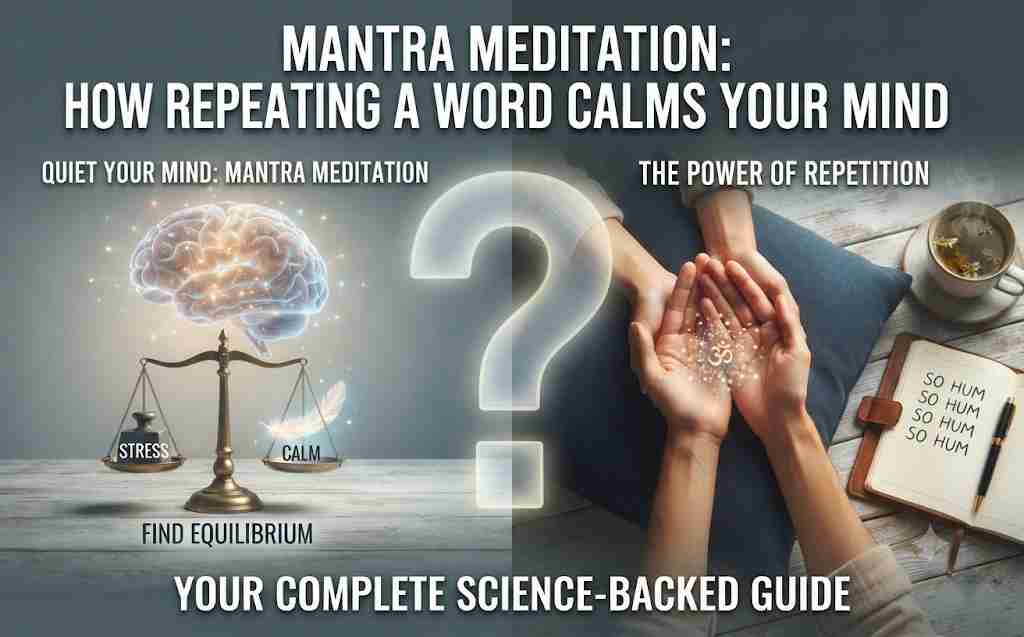
A traditional Sanskrit sound: "So Hum" (meaning "I am That"), "Om" (a sound representing universal consciousness), or the personalized mantras given in Transcendental Meditation training.
A meaningful English word or phrase: "Peace," "Let go," "Here now," "I am enough," or any phrase that carries personal resonance and positive or neutral meaning.
A neutral sound: Research suggests that meaningless sounds work as well as meaningful ones for the focusing function of the mantra — the repetition itself is the mechanism, not the semantic content.
A religious or spiritual phrase: "Hail Mary" (centering prayer), "Shema" (Jewish tradition), "Jesus" or "Maranatha" (Christian contemplative), or any phrase from one's own tradition.
For beginners without a spiritual tradition to draw from, "So Hum" is widely recommended because the sounds naturally synchronize with breathing — "So" on the inhale, "Hum" on the exhale — providing both a verbal and a breath anchor simultaneously.
How to Practice Mantra Meditation — Step by Step
Posture and Setup
Sit comfortably in a chair or on the floor with your spine upright — not rigid, but alert. Rest your hands in your lap. Close your eyes. Set a timer for 10–20 minutes (starting at 10 minutes for the first 2 weeks). Unlike breath meditation, mantra meditation is traditionally practiced with the eyes closed throughout the session.
Begin the Repetition
After a few natural breaths, silently begin repeating your chosen mantra at a natural, unhurried pace — not synchronizing it to any fixed rhythm unless the mantra naturally fits the breath (as "So Hum" does). The repetition should be effortless — the mantra is thought rather than spoken internally, with no muscular effort in the throat or mouth. Think of it as the mantra gently resonating at the level of thought rather than being forcefully generated.
When Thoughts Arise
Thoughts will arise during mantra meditation — this is expected and normal. The instruction in most traditions is not to fight thoughts or push them away, but to simply notice that the mantra has faded (replaced by a thought) and gently return to the mantra without self-criticism. Unlike breath meditation where you observe thoughts, in mantra meditation you simply return to the repetition — the mantra is the focus, and returning to it is the practice.
In Transcendental Meditation specifically, thoughts that arise are considered part of the process — as the mind settles, it naturally releases stored stress in the form of thoughts, images, and emotions. The instruction is not to engage with them but to allow them to pass by returning to the mantra.
Ending the Session
When the timer sounds, do not immediately open your eyes or stand up. Stop repeating the mantra and sit quietly for 2–3 minutes with eyes closed, allowing the transition from the meditative state back to regular waking consciousness to happen gradually. This transition period is considered important in the mantra meditation tradition — abrupt return to activity can leave practitioners feeling unsettled. Open eyes slowly and rest for a moment before resuming normal activity.
Mantra vs Breath Meditation — Which Is Right for You?
Both forms of meditation produce broadly similar benefits with somewhat different mechanisms and different experiential qualities. Breath meditation develops present-moment sensory awareness and is particularly effective for anxiety, pain management, and moment-to-moment mindfulness. Mantra meditation provides a more concrete anchor that many people find easier to work with, tends to produce deeper physiological relaxation states more quickly for many practitioners, and has the strongest clinical evidence specifically for blood pressure and cardiovascular effects. Many experienced practitioners find value in both — using breath-based mindfulness for daytime awareness practice and mantra meditation for dedicated sitting sessions.
Frequently Asked Questions
Do I need to be trained in Transcendental Meditation to practice mantra meditation?
No — while Transcendental Meditation is a formally taught program with instructors and personalized mantra assignment (and comes with a significant enrollment fee), the core practice of silent mantra repetition is accessible to anyone without formal training. Many of the research benefits attributed to TM have also been found in studies of other mantra-based practices using self-chosen mantras. Choosing "So Hum," "Peace," or any personally resonant word and practicing for 15–20 minutes twice daily will produce meaningful benefits. Those who want a structured learning environment and personalized mantra can pursue formal TM training — but it is not a prerequisite for practicing mantra meditation effectively.
Should the mantra be repeated aloud or silently?
Most mantra meditation traditions recommend silent mental repetition — thinking the mantra rather than vocalizing it. Silent repetition produces deeper physiological relaxation by keeping the body still and the breath natural. However, beginning practitioners sometimes find it helpful to whisper the mantra quietly during the first few sessions until the practice feels established, then gradually transitioning to purely internal repetition. Some traditions (chanting practices in yoga, some Buddhist traditions, Jewish davening) use vocalized repetition deliberately — this produces different but also beneficial effects, including breath regulation and community bonding in group settings.
Medical Disclaimer: This article is for informational and educational purposes only. Mantra meditation is a wellness practice and is not a substitute for professional mental health treatment or medical care for cardiovascular conditions. If you have significant anxiety, depression, or high blood pressure, please consult a qualified healthcare provider in addition to exploring meditation practices.