When most Americans decide to lose weight, they head to the treadmill. Cardio feels intuitive — you burn calories while doing it, you sweat, you feel the effort. Strength training feels less obvious. You lift something heavy and put it down. How does that burn fat?
The answer involves what happens in the 24–48 hours after you lift weights — and it changes the entire conversation about which type of exercise produces better long-term fat loss. Here's what the research shows, why strength training is particularly important for weight loss, and how to start safely as a beginner.
Quick TakeawayCardio burns calories during exercise. Strength training builds muscle that burns more calories at rest — every hour of every day. For sustainable fat loss that doesn't slow your metabolism, combining strength training with a moderate calorie deficit is significantly more effective than cardio or diet alone.
Why Cardio Alone Often Fails for Long-Term Weight Loss
Cardiovascular exercise is genuinely beneficial — for heart health, mood, and calorie burning during the session. But relying on cardio alone for weight loss has a significant limitation: the human body adapts to it efficiently. The more you run, the better your body gets at running — and the fewer calories it burns doing the same distance over time.
More critically, when people create a calorie deficit through cardio and diet without strength training, a significant portion of the weight they lose comes from muscle, not fat. Losing muscle lowers your basal metabolic rate — the number of calories your body burns at rest — making further weight loss progressively harder and making weight regain more likely when the diet ends.
What Strength Training Does Differently
Strength training — using weights, resistance bands, or bodyweight exercises — creates microscopic damage to muscle fibers during the workout. Your body repairs and rebuilds those fibers stronger and larger over the following 24–48 hours. This repair process requires significant energy — meaning your body continues burning calories at an elevated rate long after you've left the gym. This is called excess post-exercise oxygen consumption (EPOC), or informally, the "afterburn effect."
More importantly, each pound of muscle tissue burns approximately 6–10 calories per day at rest — compared to about 2 calories per pound of fat. Building and preserving muscle through strength training increases your baseline calorie burn permanently, making it easier to maintain a healthy weight long-term without extreme dietary restriction.
What the Research Shows
A comprehensive review published in the journal Obesity found that strength training was associated with significantly greater preservation of lean muscle mass during weight loss compared to diet or cardio alone. Participants who combined strength training with a calorie deficit lost more fat and less muscle than those who used cardio or diet alone — even when total weight loss was similar on the scale.
A study from the Harvard School of Public Health following over 10,000 healthy men for 12 years found that those who did 20 minutes of daily strength training gained less age-related abdominal fat than those who did the same amount of aerobic activity. Abdominal fat — particularly visceral fat surrounding organs — is the most metabolically harmful form and is strongly associated with insulin resistance and cardiovascular disease.
How Much Strength Training Do You Need?
The good news: the research-supported dose for meaningful metabolic and body composition benefits is just two to three strength training sessions per week, each lasting 30–45 minutes. You do not need to spend hours in a gym. The American College of Sports Medicine recommends two to three days per week of resistance training targeting all major muscle groups as a minimum for health benefits.
For beginners, two sessions per week is sufficient to produce noticeable changes in strength and body composition within 6–8 weeks. Rest days between sessions are important — muscle is built during recovery, not during the workout itself.
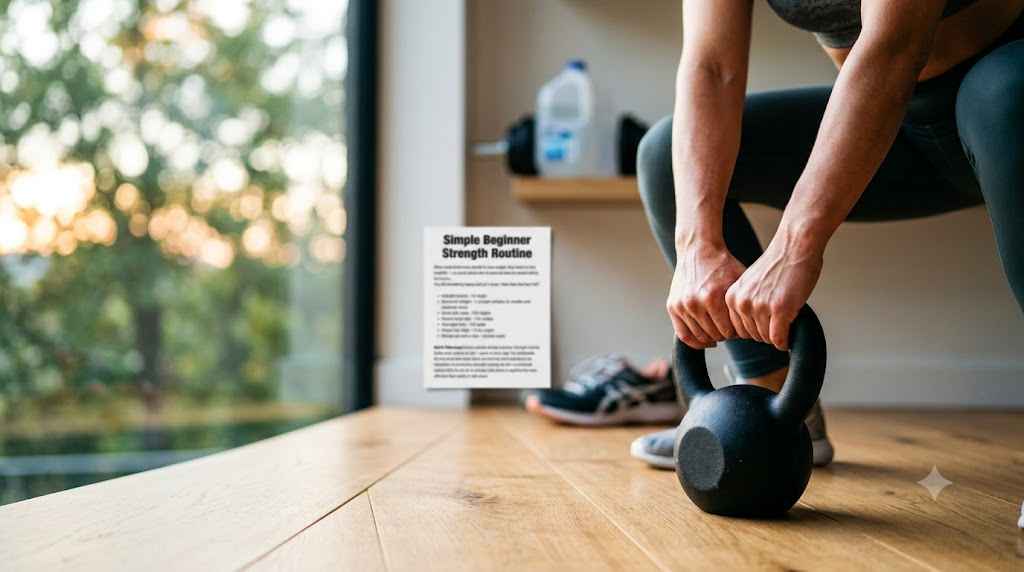
A Simple Beginner Strength Routine (No Gym Required)
The following routine uses only bodyweight and can be done at home in 30 minutes, twice per week:
Squats: 3 sets of 10–12 reps. Stand feet shoulder-width apart, lower as if sitting into a chair, return to standing. Works quadriceps, hamstrings, glutes.
Push-ups: 3 sets of 8–12 reps. Modify by dropping to knees if needed. Works chest, shoulders, triceps, core.
Glute bridges: 3 sets of 12–15 reps. Lie on your back, feet flat on floor, push hips toward ceiling. Works glutes, hamstrings, lower back.
Bent-over rows (with water jugs or dumbbells): 3 sets of 10–12 reps. Hinge at hips, pull weight toward lower chest. Works upper and middle back, biceps.
Plank: 3 sets of 20–45 seconds. Hold a push-up position on forearms. Works entire core.
Reverse lunges: 3 sets of 10 each leg. Step backward, lower back knee toward floor, return. Works quads, glutes, balance.
Rest 60–90 seconds between sets. As this becomes easier over 4–6 weeks, add resistance (heavier water jugs, resistance bands, or gym weights) or add a third weekly session.
Common Beginner Mistakes to Avoid
Skipping rest days: Muscles rebuild during rest, not during training. Training the same muscles every day prevents progress and increases injury risk.
Not eating enough protein: Muscle synthesis requires amino acids. Aim for 0.7–1 gram of protein per pound of bodyweight daily when strength training for body composition.
Using too much weight too soon: Start lighter than you think you need to. Perfect form matters more than heavy weight — especially for the first month.
Giving up after two weeks: Initial soreness (DOMS — delayed onset muscle soreness) is normal in the first 2–3 weeks. Strength gains and body composition changes typically become noticeable at 6–8 weeks. Patience is the most important variable.
Doing only arms: Large muscle groups — legs, back, glutes — burn significantly more calories and produce greater metabolic benefit than arm exercises. Lower body training is especially important for overall fat loss.
Will Strength Training Make Women "Bulky"?
This is the most common concern women have about strength training — and it's based on a fundamental misunderstanding of female physiology. Women have approximately 15–20 times less testosterone than men, making the kind of significant muscle mass gain most people associate with "bulky" essentially impossible without years of very heavy training and often pharmacological assistance. What strength training does for most women is create a leaner, more defined physique — not a larger one. The "toned" look that many women pursue is literally the result of building some muscle beneath reduced body fat.
Frequently Asked Questions
Should I do cardio or strength training first?
For weight loss and body composition goals, doing strength training before cardio is generally recommended. Strength training requires glycogen (stored carbohydrates) for fuel — doing it first ensures you have adequate energy for the most metabolically important part of your session. Cardio afterward uses more fat as a fuel source since glycogen has been partially depleted. If you prefer cardio-only days and strength-only days, that separation works equally well.
How long until I see results from strength training?
Strength (neurological adaptation) improves noticeably within 2–4 weeks — you'll be able to do more reps or lift more weight fairly quickly. Visible changes in body composition — reduced body fat, more definition — typically become noticeable at 6–12 weeks of consistent training combined with a moderate calorie deficit. The scale may not change dramatically in the first few weeks as muscle gain and fat loss can offset each other — but measurements, photos, and how clothing fits are more reliable indicators than weight alone.
Medical Disclaimer: This article is for informational and educational purposes only. Consult a healthcare provider before beginning a new exercise program, particularly if you have joint problems, cardiovascular conditions, or other health concerns. Consider working with a certified personal trainer when beginning strength training to ensure correct form and reduce injury risk.