Metabolism — the sum of all chemical processes your body uses to convert food into energy — is one of the most misunderstood concepts in weight management. Many people believe their metabolism is fixed, genetically determined, and beyond their control. The truth is more nuanced and more hopeful: while genetics do influence baseline metabolic rate, research has identified several lifestyle factors that meaningfully affect how many calories your body burns each day. Here's an evidence-based guide to how to speed up your metabolism naturally.
Quick TakeawayThe four most evidence-supported strategies for naturally speeding up metabolism are: building and preserving muscle through strength training (raises resting metabolic rate permanently), eating adequate protein (high thermic effect), staying well hydrated (dehydration slows metabolic processes), and protecting sleep quality (poor sleep measurably reduces metabolic rate).
Understanding What "Metabolism" Actually Means
Your total daily energy expenditure (TDEE) — the total calories your body burns in a day — has three main components. Basal metabolic rate (BMR) is the largest: approximately 60–70% of total calories burned at rest, just to keep basic biological functions running. The thermic effect of food (TEF) accounts for roughly 10%: the energy required to digest, absorb, and metabolize nutrients. Non-exercise activity thermogenesis (NEAT) — the energy burned in all physical activity that isn't formal exercise, including walking, fidgeting, standing, and daily tasks — makes up the remaining 20–30% and is the component most variable and most amenable to lifestyle change.
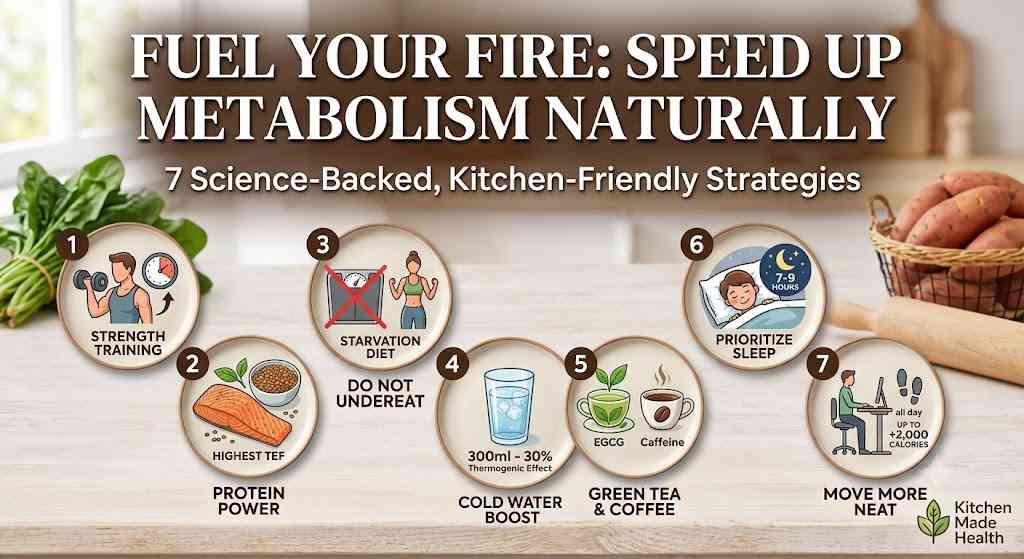
1. Build Muscle Through Strength Training
Muscle tissue is metabolically active — it burns approximately 6–10 calories per pound per day at rest, compared to about 2 calories per pound of fat. Building and preserving muscle through regular strength training is the most powerful and sustainable strategy for how to speed up your metabolism naturally over the long term.
Research consistently finds that adults who engage in regular resistance training have higher resting metabolic rates than sedentary individuals of similar age and body weight. Even two to three strength training sessions per week — targeting all major muscle groups — produces meaningful increases in metabolic rate over weeks to months. This effect compounds: more muscle means more calories burned daily, which makes maintaining a healthy weight progressively easier.
2. Eat Enough Protein
Of all macronutrients, protein has the highest thermic effect — your body burns approximately 25–30% of protein's calories just in the process of digesting and metabolizing it, compared to 6–8% for carbohydrates and 2–3% for fat. This means that simply shifting your diet toward higher protein intake creates a meaningful increase in daily calorie burn without any other changes.
Additionally, adequate protein intake is essential for preserving muscle mass during any calorie deficit. When people lose weight without adequate protein, they lose muscle alongside fat — lowering their resting metabolic rate and making future weight management more difficult. Aim for 0.7–1 gram of protein per pound of body weight daily when trying to maintain or build metabolic rate.
3. Don't Undereat — Metabolic Adaptation Is Real
One of the most counterproductive strategies for people trying to boost metabolism is severe calorie restriction. When calorie intake drops significantly below maintenance, the body responds with adaptive thermogenesis — reducing metabolic rate to conserve energy. Research has documented reductions of 15–25% in resting metabolic rate in response to significant calorie restriction, making further weight loss progressively more difficult.
Eating at a moderate deficit (300–500 calories below maintenance) rather than a severe deficit preserves more metabolic rate during weight loss. Periodic "diet breaks" — returning to maintenance calories for 1–2 weeks — have been found in research to partially restore suppressed metabolic rate during extended weight loss periods.
4. Drink Cold Water and Stay Hydrated
Mild dehydration slows metabolic processes — the enzymatic reactions of metabolism require water as both a reactant and a medium. Staying adequately hydrated ensures metabolic processes run at their optimal rate. Drinking cold water provides an additional modest thermogenic boost: your body expends energy warming cold water to core temperature. Research has found that drinking 500 ml of cold water increases metabolic rate by approximately 30% for 30–40 minutes — a modest but real effect.
5. Drink Green Tea or Coffee (Moderately)
Caffeine is one of the few substances with genuine, research-supported thermogenic effects. It stimulates the central nervous system and increases the release of epinephrine, which signals fat cells to release their stored fat for energy. Research has found that caffeine increases metabolic rate by 3–11% at doses comparable to 1–3 cups of coffee, with larger effects in leaner individuals. Green tea provides both caffeine and EGCG — a catechin that may independently enhance fat oxidation.
These effects are modest and tolerance develops with habitual use. But for people who don't already drink coffee or green tea heavily, moderate consumption (1–3 cups daily) provides a meaningful contribution to how to speed up metabolism naturally without significant risk.
6. Prioritize Sleep
Sleep deprivation directly reduces metabolic rate and disrupts the hormones that regulate it. Research has found that just one week of sleeping 5.5 hours per night compared to 8.5 hours reduced metabolic rate and shifted calorie burning away from fat oxidation toward carbohydrate oxidation. Ghrelin rises and leptin falls with poor sleep, driving increased appetite and food intake. Chronically poor sleep undermines every other metabolic strategy you might employ.
Prioritizing 7–9 hours of quality sleep is not a passive metabolic strategy — it is an active one. Sleep is when growth hormone is primarily released (supporting muscle repair and fat metabolism), when cortisol returns to its lowest levels, and when the hormonal environment for metabolic health is most favorable.
7. Increase NEAT — Move More Throughout the Day
Non-exercise activity thermogenesis (NEAT) — the calories burned through all daily movement that isn't structured exercise — varies enormously between individuals and accounts for up to 2,000 calories per day difference between very active and very sedentary people of the same size. Simple increases in NEAT can meaningfully boost total daily calorie burn without any formal workout.
Practical NEAT boosters: stand at a desk for portions of the workday, take the stairs consistently, park farther away, take 5-minute walking breaks every hour, do household tasks more actively, and walk while taking phone calls. Research on NEAT consistently finds it to be one of the most variable and most underutilized components of total daily energy expenditure.
Frequently Asked Questions
Does eating spicy food actually boost metabolism?
Yes, but modestly. Capsaicin — the active compound in chili peppers — has a mild thermogenic effect, temporarily raising metabolic rate by approximately 4–5% for 30 minutes after consumption. Over time, regular capsaicin consumption may also slightly reduce appetite. The effect is real but small — not sufficient to drive meaningful weight loss on its own, but a pleasant addition to a broader strategy for how to speed up metabolism naturally.
Does metabolism permanently slow with age?
Research published in Science in 2021 found that metabolic rate remains remarkably stable between ages 20 and 60 — contradicting the common belief that metabolism slows significantly in early adulthood. The weight gain many people experience in their 30s and 40s appears to be more related to declining physical activity, muscle loss from reduced activity, and lifestyle changes than to metabolism itself. After age 60, a genuine but gradual decline in metabolic rate begins. Strength training throughout adulthood is the most effective strategy for preserving metabolic rate with aging.
Medical Disclaimer: This article is for informational and educational purposes only. It is not intended to provide medical or nutritional advice for weight management. Consult a qualified healthcare provider or registered dietitian before making significant changes to your diet or exercise routine.