You've cut back on portions. You're skipping dessert. You're eating salads for lunch. And the scale hasn't budged. If this sounds familiar, you're far from alone — it's one of the most common frustrations in weight loss, and it has a name: the weight loss plateau. But sometimes it happens right from the start, which is even more confusing.
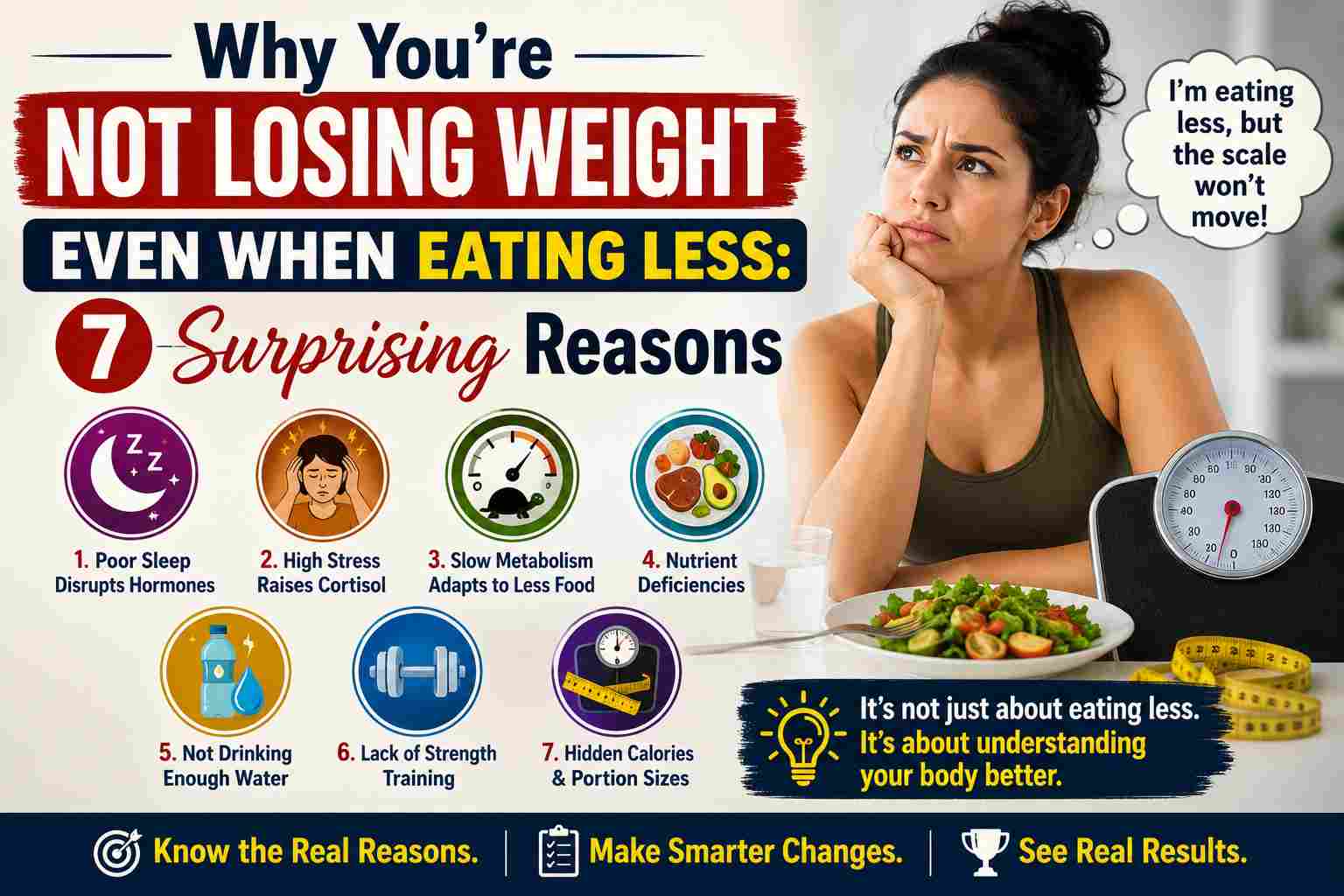
The truth is that calorie intake is only one piece of a complex puzzle. Here are seven science-backed reasons why reducing your food intake alone may not be enough — and what you can actually do about each.
Quick TakeawayWeight loss involves far more than just calories in vs. calories out. Sleep, stress hormones, muscle mass, gut health, and even how you're measuring "eating less" all play meaningful roles. Addressing these factors often breaks a frustrating plateau.
1. You're Underestimating How Much You're Eating
Research has consistently found that people — including healthcare professionals — significantly underestimate their calorie intake when estimating portions without measuring. Liquid calories from coffee drinks, dressings, cooking oils, and beverages are especially easy to miss. A "tablespoon" of peanut butter that's really two tablespoons adds up faster than most people realize.
What to do: For one week, track your food intake using a free app like MyFitnessPal or Cronometer — not to obsess over numbers, but to get an accurate picture of your actual intake. Most people are genuinely surprised by what they find.
2. Poor Sleep Is Sabotaging Your Efforts
Sleep deprivation has a surprisingly powerful effect on weight regulation. Research has found that even a few nights of poor sleep significantly raises levels of ghrelin (the hunger hormone) and reduces levels of leptin (the satiety hormone). This hormonal shift leads to increased appetite — especially for high-calorie, carbohydrate-rich foods — and reduced willpower to resist them.
One well-known study found that participants on a calorie-restricted diet who slept 5.5 hours per night lost significantly less fat and more lean muscle than those who slept 8.5 hours on the same diet.
What to do: Prioritize 7–9 hours of quality sleep as part of your weight management strategy. This is not optional — it's foundational.
3. Chronic Stress Is Raising Your Cortisol
Cortisol, the body's primary stress hormone, has a direct relationship with fat storage — particularly around the abdomen. Chronically elevated cortisol (from work stress, financial pressure, relationship tension, or even intense exercise without adequate recovery) signals the body to hold onto fat as an energy reserve.
Cortisol also drives cravings for calorie-dense, sugary, and salty foods — which is why stress eating is a real physiological response, not just a lack of willpower.
What to do: Incorporate stress-reduction practices into your daily routine — even 10 minutes of deep breathing, a short walk outdoors, or progressive muscle relaxation can help lower cortisol over time. Consistent moderate exercise (not chronic overtraining) also helps regulate cortisol.
4. You've Lost Muscle Along with Fat
When you cut calories significantly without including strength training, your body often breaks down muscle tissue for energy along with fat. This is a problem because muscle is metabolically active tissue — it burns more calories at rest than fat does. Losing muscle lowers your resting metabolic rate, meaning you need fewer calories to maintain your weight. This creates a downward spiral where further calorie restriction becomes necessary just to maintain the same deficit.
What to do: Include resistance training (bodyweight exercises, free weights, resistance bands) at least 2–3 times per week. Combine this with adequate protein intake (research generally supports 0.7–1g per pound of body weight for active individuals trying to preserve muscle while losing fat).
5. Your Body Has Adapted to Your Calorie Level
The human body is remarkably good at adapting to reduced calorie intake — a survival mechanism from our evolutionary history. When you consistently eat less, your body responds by lowering its metabolic rate (adaptive thermogenesis), reducing non-exercise movement (like fidgeting and spontaneous activity), and becoming more efficient at extracting energy from food.
This is one reason weight loss often slows dramatically after an initial period of success, even when nothing in your diet has changed.
What to do: Periodically eating at maintenance calories (sometimes called a "diet break") for 1–2 weeks can help restore metabolic rate and hormone levels. Cycling calorie intake rather than maintaining a constant deficit may support long-term results.
6. Your Gut Microbiome May Be Working Against You
Emerging research on the gut microbiome suggests that the trillions of bacteria living in your digestive tract influence how efficiently you extract calories from food, how fat is stored, and even your appetite and cravings. People with less diverse gut microbiomes — often associated with diets high in ultra-processed foods — may extract more calories from the same foods than people with healthier, more diverse gut bacteria.
What to do: Support gut diversity by eating a wide variety of plant foods (research suggests 30+ different plant foods per week), including fermented foods (plain yogurt, kefir, kimchi, sauerkraut), and reducing ultra-processed food intake. Prebiotic fibers from garlic, onions, oats, and bananas feed beneficial bacteria.
7. Underlying Health Factors May Be at Play
In some cases, difficulty losing weight despite genuine calorie restriction may be related to an underlying health condition. Hypothyroidism (underactive thyroid), polycystic ovary syndrome (PCOS), insulin resistance, and certain medications are all associated with weight gain or resistance to weight loss. These conditions are more common than many people realize.
What to do: If you've genuinely addressed the lifestyle factors above and weight loss remains elusive, a conversation with your doctor — including bloodwork to check thyroid function, insulin levels, and other markers — is a worthwhile next step. Weight loss is never "just about willpower" when physiology is working against you.
Frequently Asked Questions
How long does a weight loss plateau typically last?
Most plateaus last anywhere from a few weeks to a few months. They're a normal part of any weight loss journey and signal that your body has adapted to your current approach. Adjusting your strategy — adding strength training, varying your calorie intake, improving sleep — is usually more effective than simply cutting more calories.
Is it possible to not lose weight on a calorie deficit?
In theory, a true calorie deficit always produces fat loss over time. However, factors like water retention (which can mask fat loss on the scale), inaccurate calorie tracking, metabolic adaptation, and hormonal factors can all make it appear as though no loss is occurring. Day-to-day scale fluctuations of 1–3 pounds are normal and not indicative of actual fat change.
Medical Disclaimer: This article is for informational and educational purposes only. It is not intended to provide medical advice or replace professional guidance. Always consult a qualified healthcare provider or registered dietitian before beginning any weight loss program, particularly if you have underlying health conditions.Start writing your guide…