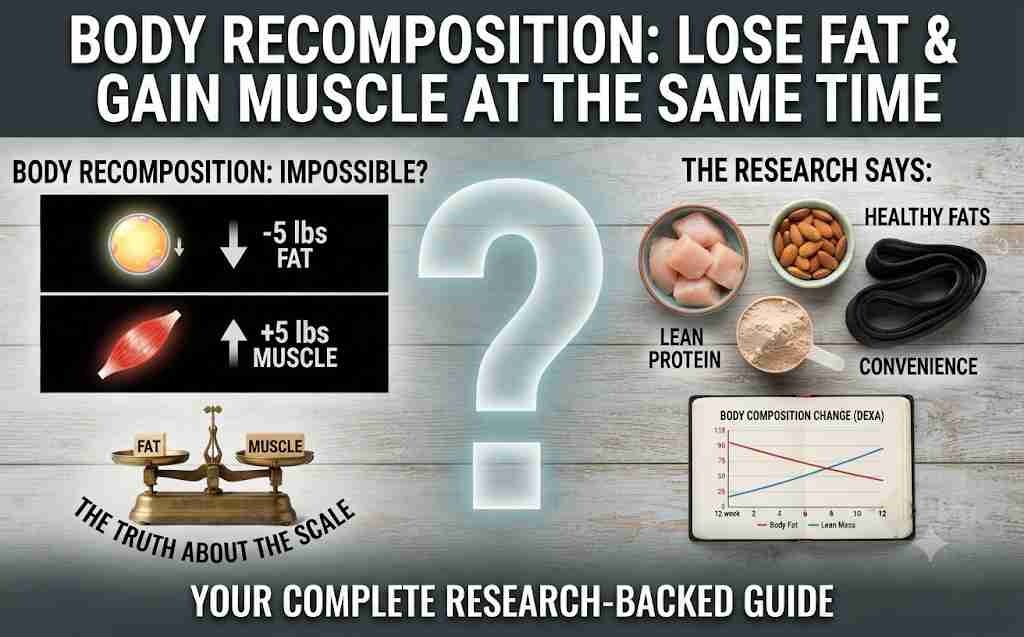
Body recomposition — simultaneously losing body fat while gaining lean muscle mass — is often described as impossible or reserved for beginners and steroid users. This characterization significantly understates what the research shows. While simultaneous fat loss and muscle gain is more difficult to achieve than doing one or the other exclusively, it is achievable for a meaningful proportion of people — particularly those new to strength training, those returning after a break, those with significant body fat to lose, and those willing to optimize both their diet and training simultaneously.
Here's what body recomposition is, who it works best for, and the specific approach that the research supports.
Quick TakeawayBody recomposition requires two things happening simultaneously: a mild calorie deficit (to lose fat) and adequate protein with strength training stimulus (to build or preserve muscle). The scale may not change much — because fat loss and muscle gain can offset each other — but body composition measurably improves. Progress is best measured by body measurements, clothing fit, and how you look and feel, not the number on the scale.
Why Conventional Wisdom Says It's Impossible
Traditional sports science holds that fat loss requires a calorie deficit, while muscle building requires a calorie surplus — and since you can't be in both states simultaneously, the two goals are mutually exclusive. This logic is clean in theory and does apply to some populations — particularly advanced athletes who are already lean and highly trained. For them, simultaneous fat loss and muscle gain is indeed very difficult.
However, this reasoning overlooks several realities: the body has fat stores it can use to fuel muscle synthesis without dietary surplus; muscle protein synthesis and fat oxidation can occur in different tissue compartments simultaneously; and newer research using precise body composition measurement (DEXA scans rather than scale weight) has repeatedly documented simultaneous fat loss and muscle gain in study participants.
Who Can Achieve Body Recomposition Most Effectively
Body recomposition works best for specific populations:
Beginners to strength training: People new to lifting experience the strongest "newbie gains" — the period where the neuromuscular system adapts rapidly and muscle protein synthesis is elevated even in a calorie deficit. This window is the best opportunity for body recomposition available to most people.
People returning after a break: Muscle memory — the documented phenomenon where previously trained muscle regains mass faster than it was originally built — allows returning exercisers to build muscle more efficiently, even in a slight deficit.
People with significant body fat to lose: When body fat stores are substantial, the body has ample stored energy to fuel muscle synthesis without dietary surplus. The larger the fat reserve, the more effectively it can be mobilized to support muscle building during a deficit.
People transitioning from sedentary to active: Simply adding structured exercise to a previously sedentary lifestyle, without significant dietary change, often produces body recomposition — fat stores drop as activity increases while new muscle is built by the training stimulus.
The Diet Strategy for Body Recomposition
Mild Calorie Deficit — Not Aggressive
The calorie deficit for body recomposition must be mild — typically 200–400 calories below maintenance — rather than the aggressive 500–1,000 calorie deficit used for rapid weight loss. An aggressive deficit signals the body to prioritize survival over muscle building, shifting protein breakdown rates upward and reducing muscle protein synthesis. A mild deficit creates conditions where fat stores are gradually mobilized while muscle building remains feasible.
High Protein — The Non-Negotiable
Protein intake is the most critical dietary variable for body recomposition. Research consistently finds that higher protein intake during a calorie deficit preserves or builds muscle more effectively than lower protein intake — regardless of the source of the calories saved. The research-supported target for body recomposition is 0.7–1.0 grams of protein per pound of body weight daily — significantly higher than the general population RDA of 0.36g per pound. At 180 pounds, this means 126–180 grams of protein daily. Prioritize high-quality complete proteins: chicken, fish, eggs, Greek yogurt, cottage cheese, lean beef, and legumes.
Protein Timing Matters
Distributing protein evenly across meals — rather than consuming most of it at dinner — maximizes muscle protein synthesis throughout the day. Research has found that consuming 25–40 grams of protein per meal produces near-maximal muscle protein synthesis stimulus at each meal, while larger amounts at a single meal don't proportionally increase synthesis. Four meals with 30–40g of protein each outperforms one large protein serving for body recomposition purposes.
The Training Strategy for Body Recomposition
Strength Training Is Non-Negotiable
Cardio alone cannot produce body recomposition — it can reduce body fat but provides insufficient stimulus for muscle building. Strength training provides the mechanical tension signal that triggers muscle protein synthesis. For body recomposition, 3–4 strength training sessions per week targeting all major muscle groups is the research-supported minimum. Each session should include compound movements — squats, deadlifts, rows, presses — that engage the largest muscle groups and produce the greatest anabolic stimulus.
Progressive Overload
Muscles adapt to training stress and stop growing when the challenge plateaus. Progressive overload — gradually increasing the weight, reps, or sets over time — is required to continuously stimulate new muscle protein synthesis. Even small increases — 2.5 pounds added to a lift every 1–2 weeks — maintain the adaptive stimulus over months of consistent training. Without progressive overload, body recomposition plateaus regardless of protein intake.
Measuring Body Recomposition Progress
The scale is a poor tool for measuring body recomposition progress because fat loss and muscle gain can offset each other — producing little to no change in total weight while body composition measurably improves. More useful measurements include: weekly circumference measurements (waist, hips, thighs, arms), monthly progress photos in the same lighting and position, how clothing fits over time, and strength progression in the gym (how much you lift). DEXA scans, available at some US medical imaging centers and university exercise science labs, provide the most precise body composition measurement available but aren't necessary for most people.
Frequently Asked Questions
How long does body recomposition take to show visible results?
Body recomposition is slower than either aggressive fat loss or aggressive muscle building in isolation — precisely because it's doing both simultaneously at a moderate pace. Most people begin to notice visual changes at 8–12 weeks of consistent effort: clothes fitting differently, slightly more muscle definition, measurably reduced waist circumference. Significant visible transformation typically takes 6–12 months of consistent training and diet discipline. The payoff is a more sustainable result than crash dieting — because the muscle built during the process maintains metabolic rate and makes long-term weight management significantly easier.
Do I need supplements for body recomposition?
No supplements are required for body recomposition — protein and training are the essential variables, both of which can be optimized through food and exercise without supplementation. Protein powder (whey, casein, or plant-based) is a convenient tool for reaching high daily protein targets but is not superior to whole food protein sources. Creatine monohydrate has the strongest evidence base of any sports supplement — research consistently finds it increases strength output during training and modestly enhances muscle gain over time — and is safe for long-term use at 3–5g daily. Discuss any supplementation with your healthcare provider.
Medical Disclaimer: This article is for informational and educational purposes only. Consult a healthcare provider before beginning a new exercise or dietary program, particularly if you have existing health conditions. Consider working with a registered dietitian and certified personal trainer for personalized body recomposition guidance.