Cold sores — the small, painful blisters that appear on or around the lips — are caused by herpes simplex virus type 1 (HSV-1), which infects an estimated 67% of the global population under age 50. After initial infection (often in childhood, sometimes without symptoms), HSV-1 remains permanently dormant in the trigeminal nerve ganglion — a cluster of nerve cells near the base of the skull. It stays dormant indefinitely unless something reactivates it, at which point it travels down the nerve to the skin surface and causes the familiar outbreak.
Understanding cold sore triggers is the most powerful prevention strategy available. While no natural remedy can eliminate the virus once established, identifying and managing personal triggers can dramatically reduce the frequency, severity, and duration of outbreaks.
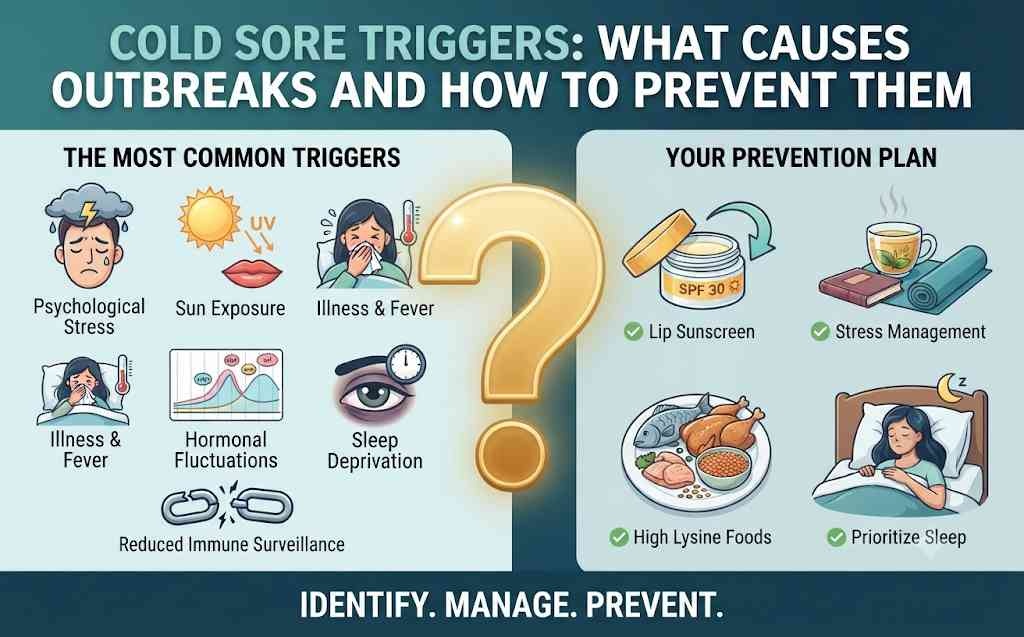
Quick TakeawayCold sore outbreaks occur when the dormant HSV-1 virus is reactivated by a drop in immune surveillance — the immune system's normal suppression of the virus temporarily falters, allowing reactivation. Anything that stresses the immune system or reduces immune vigilance is a potential trigger. The most common triggers are psychological stress, UV sun exposure, illness, hormonal fluctuations, and sleep deprivation.
The Most Common Cold Sore Triggers
1. Psychological Stress
Emotional stress is the most consistently reported cold sore trigger — and the most well-documented in research. Psychological stress elevates cortisol, which suppresses T-cell immune function — specifically the CD8+ T-cells that maintain HSV-1 in its dormant state in nerve ganglia. When cortisol rises significantly, immune surveillance weakens enough to allow viral reactivation. Research has found that people with higher psychological stress show significantly higher rates of cold sore recurrence, and that stress management interventions reduce outbreak frequency.
Prevention strategy: The same stress reduction tools covered in our Mental Wellness category — sleep, exercise, breathing practices, social connection — directly reduce cortisol and strengthen the immune surveillance that keeps HSV-1 dormant. People who experience cold sores consistently in response to stressful periods benefit most from proactive stress management.
2. Sun Exposure (UV Radiation)
UV radiation from sun exposure is one of the most reliably documented cold sore triggers — and among the most easily managed. UV light directly damages local immune function in the skin and lip area, creating a window of reduced immune surveillance that allows HSV-1 reactivation. Many people notice a consistent pattern of cold sores appearing 2–5 days after significant sun exposure, particularly in summer or after ski trips (where UV exposure is intensified by snow reflection).
Prevention strategy: Apply SPF 30 or higher lip balm whenever spending extended time outdoors. This single intervention has been found in clinical studies to significantly reduce sun-triggered cold sore recurrence. Reapply every 2 hours during extended outdoor activity.
3. Illness and Fever
Cold sores were historically called "fever blisters" because outbreaks frequently accompany colds, flu, and other viral or bacterial infections. The mechanism is twofold: the immune system is redirected toward fighting the new infection, temporarily reducing surveillance of HSV-1; and fever itself (elevated body temperature) can directly trigger HSV-1 reactivation. This trigger is largely unavoidable when illness occurs — the focus should be on immune system support through adequate sleep, vitamin C-rich foods, and zinc to reduce the severity of both the triggering illness and the resulting cold sore.
4. Hormonal Fluctuations
Many women notice a consistent relationship between their menstrual cycle and cold sore outbreaks — particularly in the luteal phase (the week before menstruation) when estrogen and progesterone both drop and immune function transiently weakens. Hormonal changes during pregnancy and menopause can also affect outbreak frequency. This trigger reflects the direct relationship between sex hormones and immune regulation — estrogen in particular has immunomodulatory effects that influence HSV-1 suppression.
Prevention strategy: Women who experience consistent menstrual-cycle-related outbreaks may benefit from increased lysine intake (see below), proactive lip sun protection, and optimized sleep during the premenstrual week — the period of greatest vulnerability.
5. Sleep Deprivation
Sleep is when the immune system performs its most intensive maintenance and surveillance work. Chronic sleep deprivation reduces natural killer cell activity, T-cell count and function, and the production of cytokines that keep HSV-1 dormant. Research has found that even short-term sleep restriction (5–6 hours per night for one week) produces measurable immune suppression sufficient to increase viral reactivation risk. This makes sleep protection one of the most direct cold sore prevention strategies available.
6. Lip Trauma and Dental Procedures
Physical trauma to the lip area — aggressive dental work, lip biting, very dry and chapped lips, certain lip fillers — can trigger local HSV-1 reactivation in the distribution of the nerve endings in the traumatized area. People with frequent cold sores should inform dentists before major dental procedures, as prophylactic antiviral medication (prescription) can prevent procedure-triggered outbreaks in high-frequency sufferers.
Dietary Factors: The Lysine-Arginine Balance
One of the most practical dietary levers for cold sore prevention involves two amino acids: lysine and arginine. HSV-1 requires arginine to replicate — it uses arginine as a building block for viral protein synthesis. Lysine competes with arginine for absorption in the intestine and also interferes with arginine's availability for viral replication. Research has found that increasing dietary lysine and reducing dietary arginine can reduce cold sore recurrence frequency and shorten outbreaks.
Foods High in Lysine (Protective)
Fish and shellfish (especially cod, sardines) — excellent lysine-to-arginine ratio
Chicken and turkey — high lysine, lower arginine
Eggs — good lysine source
Dairy products — milk, yogurt, cheese are rich in lysine
Legumes — lentils and chickpeas have a favorable lysine profile
Foods High in Arginine (Reduce During Outbreaks)
Nuts — particularly peanuts, almonds, walnuts (high arginine)
Chocolate and cocoa — very high arginine content
Seeds — pumpkin, sesame, sunflower seeds
Whole grains — oats, wheat germ are arginine-rich
During an active outbreak or at the first sign of prodrome (the tingling sensation that precedes visible blisters), temporarily increasing lysine-rich foods and reducing arginine-rich foods may help reduce severity and duration. Lysine supplements (500–1,000mg daily) are widely available and have modest clinical evidence for reducing outbreak frequency.
Recognizing the Prodrome — Your Prevention Window
Most people who experience recurrent cold sores recognize a prodromal phase — a tingling, itching, or burning sensation at the outbreak site that precedes visible blister formation by 1–2 days. This prodrome phase is the most important window for intervention: topical treatments applied at the first tingle are significantly more effective than those applied after the blister has formed. Abreva (docosanol), available over-the-counter, is the only FDA-approved OTC topical treatment and works best when started at the first tingle. Prescription antivirals (acyclovir, valacyclovir) started at prodrome are even more effective.
Frequently Asked Questions
Can I prevent cold sores entirely with natural approaches?
Natural trigger management can significantly reduce outbreak frequency for many people — but cannot guarantee complete prevention since HSV-1 reactivation involves complex immune-viral dynamics that are not fully controllable through lifestyle alone. People with frequent, severe, or cosmetically distressing outbreaks (6 or more per year) should discuss prescription antiviral suppressive therapy with a healthcare provider — daily low-dose acyclovir or valacyclovir can reduce outbreak frequency by 70–80% and is safe for long-term use. Natural approaches and prescription suppressive therapy can be used together effectively.
Are cold sores contagious even when not visible?
Yes — HSV-1 undergoes asymptomatic shedding (release of viral particles from the skin without visible sores) in people who carry the virus. This makes transmission possible even when no cold sore is present, though the risk is highest when an active sore is present and for 1–2 days after it has healed completely. Avoiding direct oral contact (kissing, sharing utensils or lip balm) during active outbreaks is the most important transmission prevention step. Note that HSV-1 oral infection and HSV-1 genital infection are distinct — discuss any concerns about transmission with a healthcare provider.
Medical Disclaimer: This article is for informational and educational purposes only. Cold sores are caused by herpes simplex virus and cannot be cured. For frequent, severe, or medically concerning outbreaks, consult a qualified healthcare provider for antiviral treatment options. This article does not constitute medical advice.