When you vividly imagine doing something — performing a skill, experiencing a place, going through a process — your brain activates many of the same neural pathways it would activate during the actual experience. This is not metaphor or self-help philosophy. It is a reproducible finding in cognitive neuroscience: the brain's motor cortex activates when you imagine movement, the visual cortex activates when you imagine images, and emotional processing regions activate when you imagine emotional scenarios. This overlap between imagined and actual experience is the foundation of visualization meditation's practical power.
Visualization has been used systematically by elite athletes since the 1970s, by cancer patients for immune support, by surgery patients for recovery, by performers managing stage fright, and by people managing chronic pain. Here's how to apply it across these different use cases.
Quick TakeawayVisualization meditation is most effective when imagery is: specific and detailed (engaging all five senses), emotionally resonant (the emotional component activates deeper neural encoding), practiced consistently (the neural pathways strengthen with repetition), and paired with physical relaxation (a relaxed body state allows deeper neural engagement with the imagery). Vague, abstract visualization produces minimal effect; vivid, sensory-rich, emotionally engaged imagery produces measurable outcomes.
The Neuroscience — Why Visualization Works
The brain doesn't perfectly distinguish between vividly imagined experience and actual experience at the level of neural activation. A series of landmark studies using fMRI (functional MRI) brain scanning established this directly: the motor cortex fires in similar patterns when athletes mentally rehearse movements as when they physically perform them. The visual cortex generates similar activity during vivid visual imagery as during actual visual perception. This "functional equivalence" between imagination and perception is the neurological basis for visualization's practical effects.
Research by Blaslotto at the University of Chicago found that basketball players who mentally practiced free throws for 20 minutes daily improved their performance almost as much as players who physically practiced — a finding replicated across numerous motor skills and sports. Research on healing visualization has found that guided imagery interventions reduce procedure-related anxiety and pain, shorten hospital stays, and in some studies produce measurable changes in immune markers.
Application 1 — Goal Visualization for Achievement
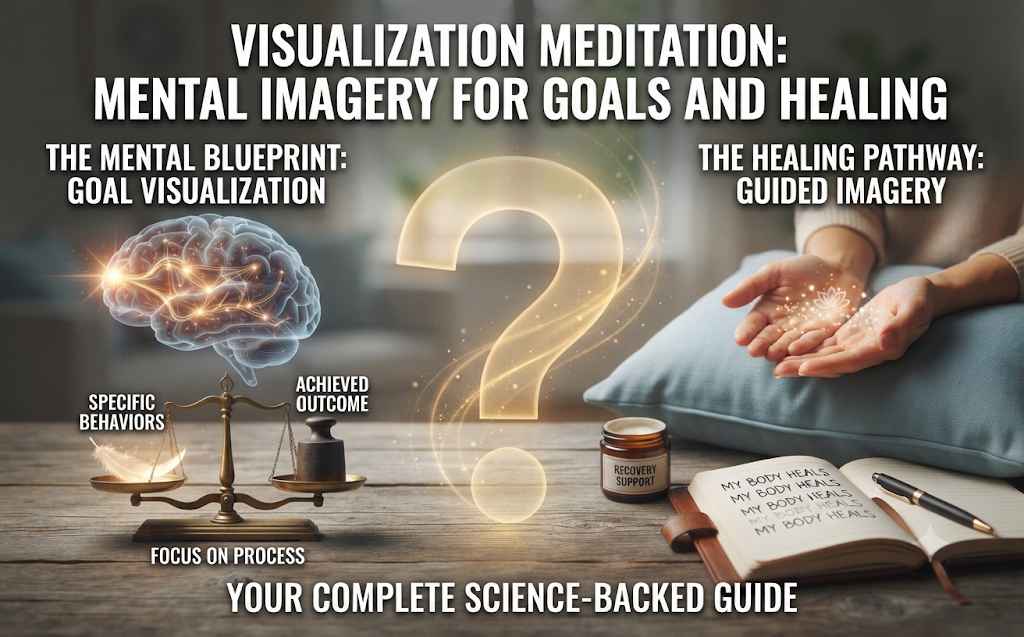
Visualization for goal achievement works best when it focuses on the process — the specific actions and feelings involved in working toward the goal — rather than the outcome alone. Research by Gabriele Oettingen found that pure "positive fantasy" visualization (only imagining the achieved outcome) can paradoxically reduce motivation by satisfying the brain's reward circuitry prematurely. Process visualization — imagining yourself taking the specific steps — increases motivation, builds neural pathways for the required behaviors, and improves performance on the actual task.
Goal Visualization Practice — 10 Minutes
Sit comfortably and close your eyes. Take 5 slow breaths to settle into a relaxed state.
Bring to mind a specific goal — not abstract ("be healthier") but concrete ("complete my morning workout without skipping").
Visualize yourself performing the specific behaviors that lead to that goal, in detail. See yourself waking up, putting on workout clothes, beginning the workout. Feel the physical sensations — the temperature, your breathing, the movement of your muscles.
Include the emotional experience — the satisfaction of following through, the energy mid-workout, the pride at completion. Emotional engagement deepens neural encoding.
Anticipate and mentally rehearse obstacles: visualize yourself encountering the urge to skip and choosing to go anyway. This obstacle rehearsal is the element most research identifies as critical for real-world follow-through.
End with 2 minutes of gratitude for having completed the imagined action, then open your eyes.
Application 2 — Healing Visualization
Healing visualization — sometimes called guided imagery — uses mental imagery to support the body's healing processes during illness, surgery recovery, or chronic pain management. While visualization cannot replace medical treatment, research has found it produces meaningful supplementary effects: reduced pre-surgical anxiety, reduced post-surgical pain medication use, shorter recovery times, and in some cancer studies, measurably improved immune natural killer cell activity.
The proposed mechanisms include: reduced cortisol (which suppresses immune function and slows healing), increased relaxation response (which enhances circulation and cellular repair processes), reduced pain catastrophizing (changing the emotional relationship to pain reduces its perceived intensity), and potentially direct neurological effects on physiological processes through the mind-body connection.
Healing Visualization Practice — 15 Minutes
Begin with a 5-minute progressive muscle relaxation or body scan to deeply relax the physical body — healing visualization works best in a state of deep physical relaxation.
Bring awareness to the area of the body you wish to support. Imagine it bathed in a warm, healing light — gold, white, or whatever color feels restorative to you. This imagery is personal and symbolic, not anatomically literal.
Visualize the healing process occurring: if recovering from surgery, imagine healthy cells multiplying and tissue knitting together cleanly. If managing chronic pain, imagine the nerve signals in the affected area calming and quieting. If supporting immune function during illness, imagine immune cells actively and effectively addressing the challenge.
Spend 5–10 minutes with this imagery, returning to it each time the mind wanders.
Close with gratitude directed toward your body for its healing capacity and resilience.
Application 3 — Performance Anxiety Visualization
For anxiety around specific performance situations — presentations, job interviews, medical procedures, social events — visualization meditation allows mental rehearsal of the feared situation in a safe, low-stakes context. By repeatedly imagining the situation and experiencing calm, confident execution in the imagination, the brain begins to associate the triggering situation with competence rather than threat.
This process — systematic desensitization through imaginal exposure — is a formal therapeutic technique used in CBT. The self-directed visualization version: relax deeply, bring the feared situation to mind vividly, notice any anxiety that arises, then deliberately imagine yourself navigating it calmly and competently. Repeat until the imagined scenario produces minimal anxiety. The reduced anxiety generalizes partially to the real situation when it occurs.
Application 4 — Pain Management Visualization
Visualization for pain management has specific techniques developed and studied in clinical pain management settings. The most effective approaches change the sensory qualities of pain in the imagination — imagining the pain as a color that gradually shifts to a cooler, calmer color; imagining a warm, soothing sensation replacing the pain; or imagining turning down a mental "volume dial" on the pain signal. These imagery techniques engage the brain's top-down pain modulation pathways — the same pathways involved in placebo effects and in why emotional state affects pain perception so dramatically.
Frequently Asked Questions
What if I struggle to visualize and can't "see" clear mental images?
Approximately 2–3% of people have aphantasia — a neurological variant where mental imagery is absent or very weak. For most people who feel they "can't visualize," the issue is simply unfamiliarity with deliberately generating and sustaining mental images — a skill that improves with practice. If visual imagery is difficult, engage other senses: feel the physical sensations of the imagined scenario, hear the sounds, notice the emotional experience. Research finds that multi-sensory visualization (not exclusively visual) produces equivalent or greater neural activation than purely visual imagery — you don't need to "see" clearly to benefit from the practice.
How long does it take for visualization practice to produce results?
For performance goals, research finds measurable effects on performance after 2–4 weeks of daily 10–15 minute practice — with continued improvement over months. For anxiety reduction, the systematic desensitization effect typically becomes noticeable after 4–6 sessions of imaginal exposure to the feared scenario. For healing and pain management, most clinical studies show meaningful effects at 3–6 weeks of consistent practice. Visualization is more immediately effective as a relaxation and acute anxiety-reduction tool — single sessions produce measurable changes in physiological arousal — than as a long-term skill-building or healing modality, which requires sustained consistent practice.
Medical Disclaimer: This article is for informational and educational purposes only. Visualization and guided imagery are complementary wellness practices and are not substitutes for medical treatment. For pain management, healing from illness or surgery, or clinical anxiety, always work with qualified healthcare providers and integrate visualization as a supplement to, not a replacement for, professional care.