Bone density is one of the most consequential and least-discussed aspects of women's long-term health. Most women don't think about their bones until a fracture or an osteoporosis diagnosis — often in their 60s or 70s. But bone density is built and maintained through choices made decades earlier, and the window between age 40 and menopause is one of the most critical periods for bone preservation. Women can lose up to 20% of their bone density in the first 5–7 years after menopause, and the trajectory of that loss is substantially influenced by bone density entering the transition.
Here's the evidence-based guide to building and preserving bone density after 40 through specific food choices, targeted exercise, and lifestyle factors.
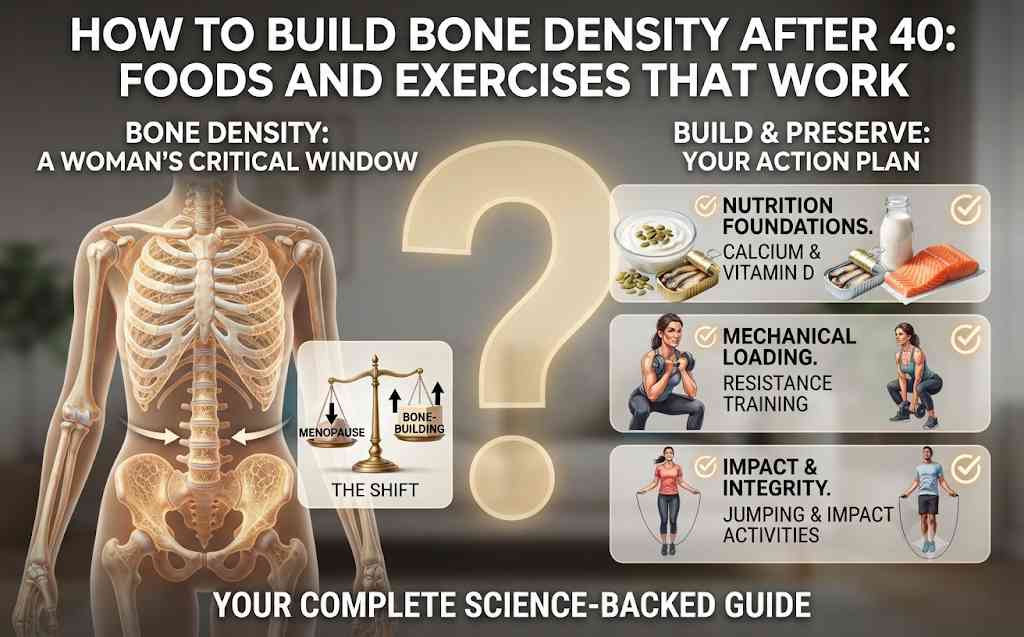
Quick TakeawayBone is living tissue that continuously remodels — osteoblasts build bone while osteoclasts break it down. After 40, the balance tips toward breakdown unless actively countered. The three most powerful modifiable factors are: adequate calcium and vitamin D intake, mechanical loading through weight-bearing and resistance exercise, and estrogen level management during the menopause transition.
Why Women Over 40 Are at Higher Risk
Several factors converge to make the period between age 40 and the postmenopausal years particularly critical for bone health. Estrogen directly suppresses osteoclast activity — the cells that break down bone tissue. As estrogen levels begin fluctuating and declining in perimenopause, osteoclast activity increases while osteoblast (bone-building) activity decreases, tipping the balance toward net bone loss. This is why the 5–7 years around the menopause transition represent the fastest rate of bone loss in a woman's lifetime — faster even than the gradual age-related loss that continues afterward.
Women also tend to have smaller, less dense bones than men to begin with, and live longer — meaning they spend more years in the post-estrogen, higher bone-loss period that follows menopause. The combination produces statistics like the lifetime fracture risk for a 50-year-old American woman being estimated at 40–50% — comparable to the lifetime risk of heart disease.
The Best Foods for Building Bone Density After 40
Calcium-Rich Foods — The Foundation
Calcium is the primary mineral in bone — approximately 99% of the body's calcium is stored in bones and teeth. The recommended intake increases from 1,000mg daily for women under 50 to 1,200mg daily for women over 50. Despite the association between dairy and calcium, non-dairy sources can fully meet calcium needs:
Plain yogurt — 415mg per cup (best dairy source)
Sardines with bones — 325mg per 3oz (exceptional non-dairy source)
Fortified plant milk — 300–450mg per cup (varies by brand — check labels)
Firm tofu made with calcium sulfate — 200–400mg per half cup
Kale cooked — 180mg per cup (bioavailability is high — low oxalate content)
Bok choy — 160mg per cup cooked
Sesame seeds (tahini) — 88mg per tablespoon
Vitamin D — The Calcium Enabler
Calcium cannot be adequately absorbed without vitamin D — which is why calcium supplementation without adequate vitamin D status produces minimal bone health benefit. Vitamin D deficiency is extremely common in American women, particularly in northern latitudes, in women who wear sunscreen consistently, and in dark-skinned women whose skin produces less vitamin D per sun exposure. The recommended intake for bone health is 600–800 IU daily from dietary sources, but research suggests many women need 1,500–2,000 IU to maintain optimal blood levels (above 40 ng/mL). Best food sources: salmon (450–600 IU per 3oz), canned tuna (150 IU), fortified milk and plant milks (100–130 IU per cup), egg yolks (40 IU each).
Magnesium — The Underappreciated Bone Mineral
Approximately 60% of the body's magnesium is stored in bone — and magnesium is required for both the activity of vitamin D and the structural integrity of the bone crystal. Low magnesium is associated with lower bone density and higher fracture risk independently of calcium and vitamin D. Best sources: pumpkin seeds (168mg per oz), dark leafy greens, almonds, black beans, and avocado.
Vitamin K2 — The Traffic Director for Calcium
Vitamin K2 is an often-overlooked bone health nutrient that directs calcium into bone rather than into arterial walls (where excess calcium deposits contribute to cardiovascular disease). K2 activates osteocalcin — a protein that binds calcium into the bone matrix. Research has found K2 supplementation associated with reduced fracture risk and improved bone mineral density. Best food sources: natto (fermented soybeans — extraordinary K2 source, 1000mcg per 100g), hard cheeses, and egg yolks. Supplemental K2 (MK-7 form, 90–120mcg daily) is worth discussing with your healthcare provider, particularly if you take blood thinners (which interact with vitamin K).
Protein — Bone's Structural Scaffolding
Bone is not purely mineral — approximately 30% of bone is collagen protein that provides the flexible matrix in which minerals are deposited. Adequate protein intake is required to maintain this collagen scaffold. Contrary to older concerns that high-protein diets leach calcium from bone, research now consistently finds that adequate to higher protein intake is associated with better bone density and lower fracture risk — particularly when calcium intake is also adequate.
The Best Exercises for Building Bone Density After 40
Weight-Bearing Exercise
Mechanical loading — the force of gravity and muscle pull on bone — is the primary stimulus for osteoblast activity (bone building). Bone responds to the mechanical stress of weight-bearing by building denser, stronger structure. Non-weight-bearing exercise (swimming, cycling) provides cardiovascular benefit but minimal bone density stimulus. The most bone-building forms of exercise for women over 40:
Walking (brisk) and hiking: Weight-bearing baseline — better than nothing, though less stimulating than resistance training for dense cortical bone
Resistance training: The most potent bone-building exercise stimulus available — the pull of muscles on bone during resistance exercise creates the highest mechanical loads and the strongest osteoblast activation. Research has found resistance training produces significant bone density gains even in postmenopausal women.
Impact activities: Jumping, skipping, racquet sports, and dancing provide high-impact loading that is particularly effective for bone density — the brief high-force impacts stimulate bone remodeling more intensely than sustained low-impact activity. Even 50 jumps per day has been found in research to improve hip bone density in premenopausal women.
Targeted Resistance Exercises for Bone Density
These exercises provide the highest bone-loading stimulus for the sites most vulnerable to osteoporotic fracture — the hip, spine, and wrist:
Squats and deadlifts: Load the hip — the most consequential fracture site. Even bodyweight squats provide meaningful hip bone stimulus.
Rows and pull-downs: Load the spine and upper back — important for preventing the vertebral compression fractures that cause the characteristic postural changes of advanced osteoporosis.
Overhead pressing: Loads the spine and shoulders.
Heel drops: Standing flat-footed, then rising to toes and dropping back to heels with a controlled impact — specifically targets hip bone density through impact loading.
Frequently Asked Questions
Should women over 40 take calcium supplements for bone health?
Recent research has raised some concerns about high-dose calcium supplements — specifically that calcium carbonate supplements in doses above 1,000mg daily may increase cardiovascular risk by contributing to arterial calcification, particularly in women already at cardiovascular risk. The current recommendation is to prioritize food sources of calcium first, and supplement only the gap between dietary intake and the recommended 1,200mg daily target. If supplementing, calcium citrate is better absorbed than calcium carbonate (particularly for women over 50 who have reduced stomach acid) and can be taken without food. Always discuss calcium supplementation with your healthcare provider, particularly if you have cardiovascular risk factors.
How long does it take for exercise to improve bone density?
Bone remodeling is slow — significant increases in bone mineral density from exercise programs are typically measurable at 12–18 months in research studies. However, the bone-protective effect of regular weight-bearing and resistance exercise begins with the first session — the mechanical loading stimulus that prevents bone loss is active immediately, even before new bone formation is detectable by DEXA scan. This means starting now, even in the 40s, meaningfully changes the bone density trajectory entering and passing through the menopause transition — the critical high-loss period. Consistency over years is more important than intensity in any single session.
Medical Disclaimer: This article is for informational and educational purposes only. Osteoporosis is a medical condition requiring diagnosis through DEXA scanning and management by a qualified healthcare provider. Consult your doctor about appropriate bone density screening and discuss any supplements or exercise programs with your healthcare team before beginning.